Showing posts with label government deficit and debt. Show all posts
Showing posts with label government deficit and debt. Show all posts
Sunday, July 1, 2012
How dangerous is America's debt?
In the past three weeks, the Congressional Budget Office (CBO) has released two reports that seem to justify contradictory fiscal policies. The first calculated that the U.S. economy could be thrown into recession because of existing legislation to reduce the deficit sharply next year (the so-called fiscal cliff). The second projected that the U.S. is headed for an eventual financial crisis if the deficit is not reduced sharply. So what are we supposed to do? Obviously, America’s debt is a problem – but is it a clear and present danger, or just something we need to deal with as circumstances permit? To understand how to make smart policy choices that address both these issues, it’s helpful to take the debt numbers apart.
Read more: http://business.time.com/2012/06/12/how-dangerous-is-americas-debt/#ixzz1xaDX4vu2


Wednesday, November 30, 2011
Europe’s Disaster Is Headed Our Way
Niall Ferguson writes:
But the third reason Americans should care about Europe is more important even than the risk of a renewed financial crisis. It is the danger that what is happening in Europe today could ultimately happen here. Just a few months ago, almost nobody was worried about Italy’s vast debt, which amounts to 121 percent of GDP. Then suddenly panic set in, and Italy’s borrowing costs exploded from 3.5 percent to 7.5 percent.
Today the U.S. gross federal debt stands at around 100 percent of GDP. Four years ago it was 62 percent. By 2016 the International Monetary Fund forecasts it will be 115 percent. Economists who should know better insist that this is not a problem because, unlike Italy, the United States can print its own money at will. All that means is that the U.S. reserves the right to inflate or depreciate away its debt. If I were a foreign investor—and half the debt in public hands is held by foreigners—I would not find that terribly reassuring. At some point I might demand some compensation for that risk in the form of ... higher rates.
But the third reason Americans should care about Europe is more important even than the risk of a renewed financial crisis. It is the danger that what is happening in Europe today could ultimately happen here. Just a few months ago, almost nobody was worried about Italy’s vast debt, which amounts to 121 percent of GDP. Then suddenly panic set in, and Italy’s borrowing costs exploded from 3.5 percent to 7.5 percent.
Today the U.S. gross federal debt stands at around 100 percent of GDP. Four years ago it was 62 percent. By 2016 the International Monetary Fund forecasts it will be 115 percent. Economists who should know better insist that this is not a problem because, unlike Italy, the United States can print its own money at will. All that means is that the U.S. reserves the right to inflate or depreciate away its debt. If I were a foreign investor—and half the debt in public hands is held by foreigners—I would not find that terribly reassuring. At some point I might demand some compensation for that risk in the form of ... higher rates.
Monday, November 28, 2011
Sunday, November 27, 2011
Greece and the Euro-Becker
Gary Becker writes in an excellent post
I will discuss the following two crucial questions about Greece and the euro:
Should Greece have become part of the euro? No.
Should Greece leave the euro? Not now, but probably in the future.
I will discuss the following two crucial questions about Greece and the euro:
Should Greece have become part of the euro? No.
Should Greece leave the euro? Not now, but probably in the future.
Sunday, September 25, 2011
Tuesday, September 13, 2011
Why is America’s Budget Deficit So Large?
Martin Feldstein writes:
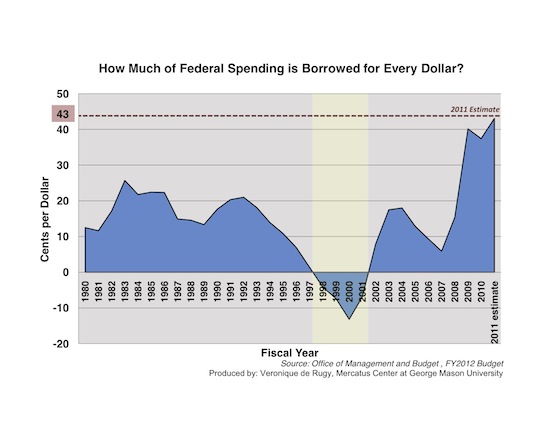
Shrinking America’s budget deficit to prevent a further rise in the debt-to-GDP ratio from its current level will require reduced spending and increased revenue.
Shrinking America’s budget deficit to prevent a further rise in the debt-to-GDP ratio from its current level will require reduced spending and increased revenue.
Monday, August 29, 2011
Deficits, Debt, and Debasement | Scott A. Beaulier and Peter J. Boettke | Cato Institute: Policy Report
In 1977 James Buchanan and Richard Wagner warned about the political legacy of Keynesian economics. "Sober assessment suggests that, politically, Keynesianism may represent a substantial disease," the two wrote in Democracy in Deficit, "one that can, over the long run prove fatal for a functioning democracy." If economic policies are not somehow constrained by rules and supermajorities, deficits are the predictable outcome of democracy. "The bottom line: political capitalism is not laissez faire capitalism," they write. "To continue down our current path is to reinforce the perverse folly of politics that has threatened the viability of the current economic system."
Deficits, Debt, and Debasement | Scott A. Beaulier and Peter J. Boettke | Cato Institute: Policy Report
Deficits, Debt, and Debasement | Scott A. Beaulier and Peter J. Boettke | Cato Institute: Policy Report
Sunday, August 21, 2011
Wednesday, August 10, 2011
Wednesday, July 27, 2011
The government as juggler
Boyes' post yesterday invites a concerned citizen to recall the warning provided by Adam Smith on this topic. Smith called the various actions outlined by Boyes as "juggling tricks" a metaphor that captures not only the recent circus in Washington, but really all activities over the past 100 years that have resulted from the activities of politicians engaged in what is euphemistically called "public finance".
Smith writes about efforts by politicians to deceive the public about the true financial condition of the state:
It occasions a general and most pernicious subversion of the fortunes of private people, enriching in most cases the idle and profuse debtor at the expence of the industrious and frugal creditor, and transporting a great part of the national capital from the hands which were likely to increase and improve it to those which are likely to dissipate and destroy it. When it becomes necessary for a state to declare itself bankrupt, in the same manner as when it becomes necessary for an individual to do so, a fair, open, and avowed bankruptcy is always the measure which is both least dishonourable to the debtor and least hurtful to the creditor. The honour of a state is surely very poorly provided for when, in order to cover the disgrace of a real bankruptcy, it has recourse to a juggling trick of this kind, so easily seen through, and at the same time so extremely pernicious.
Smith writes about efforts by politicians to deceive the public about the true financial condition of the state:
It occasions a general and most pernicious subversion of the fortunes of private people, enriching in most cases the idle and profuse debtor at the expence of the industrious and frugal creditor, and transporting a great part of the national capital from the hands which were likely to increase and improve it to those which are likely to dissipate and destroy it. When it becomes necessary for a state to declare itself bankrupt, in the same manner as when it becomes necessary for an individual to do so, a fair, open, and avowed bankruptcy is always the measure which is both least dishonourable to the debtor and least hurtful to the creditor. The honour of a state is surely very poorly provided for when, in order to cover the disgrace of a real bankruptcy, it has recourse to a juggling trick of this kind, so easily seen through, and at the same time so extremely pernicious.
Wealth of Nations - http://www.econlib.org/cgi-bin/searchbooks.pl?searchtype=BookSearchPara&id=smWN&query=juggling
Peter Boettke makes a set of observations that I find persuasive:
Scott has already talked about this at The Economic Way of Thinking, but we should dig a bit deeper into the discussion from Smith's Wealth of Nations, Vol. 2, pp. 929-2930.
Smith argues in those pages that:
(1) when the public debt reaches a certain level, the fiscal system is threatend, but there is not a single instance where a government has paid off the debt fairly and completely;
(2) rather than pay down the debt with increased taxes, government's choose "pretended payment";
(3) the prefered method of pretend payment is repudiation through debasement of the currency;
(4) this method extends the 'calamity to a great number of other innocent people'; and
(5) rather than do the right thing -- which would be least dishonorable to the debtor, and least hurtful to the creditor -- government instead choses to engage in "juggling trick".
Should these sort of issues be on the table when discussing our current public policies -- from the financial crisis to the health care debate? I think so. Perhaps for the health of the economic system and the future of our kids and grandkids, we should take the juggling power out of the hands of our political leaders.
Well, the obvious answer to the last question is yes. The problem is how? These juggling tricks are firmly institutionalized and have tremendous support, particularly in the informal institutional matrix that supports expansive government. It is the unfortunate case that the majority in the US mistakenly believe that the government can provide ___________ (fill in the blank) and, more importantly and destructively, should provide ___________ (fill in the blank). Given the manner in which the rule of law has emerged and evolved in the US, this informal belief is reflected in the tyranny of the ignorant. That said, given the widespread control of the state by special interests, I cannot be optimistic about the ability to curtail or eliminate juggling tricks.
Gavin Kennedy goes on to confirm that the use of Smith in the contemporary analysis of public choice and public finance is appropriate:
This is a case of the appropriate use of a quotation from Adam Smith’s Wealth Of Nations because it is still relevant, as government debt has increased significantly since the 18th century – in those days debt was raised mainly to fund wars or bribe foreign powers – whereas nowadays government debts fund just about anything that modern, BIG, governments spend taxpayers’ and lenders’ money upon.
Smith wrote while governments were happily inventing new forms of raising revenue for governments from the private economy. ‘Sinking Funds’ to pay-off debt soon became sources of new funds to spend more money, not always, if ever, wisely. Then they added, on a ‘temporary’ basis, income tax , and so it has gone on and on. Today, in Britain’s case, we have ‘stealth taxes’ and ‘quantitative easing’ (printing money), and unheard of levels of debt.
Smith observed that governments managed to avoid paying back all of their debt through various “juggling tricks” (beware: another one of Smith’s metaphors!).
Congratulations to Peter Boettke for picking upon Scott's references to government debt and 'juggling tricks'.
http://adamsmithslostlegacy.blogspot.com/2009/10/another-great-smithian-metephor.html
Tuesday, July 26, 2011
The Budget Debarte
When is a spending cut a spending cut? When it is not done by government. When a family cuts spending, it spends less this year than it did last year. When the government cuts spending it reduces the rate at which spending increases. The Congressional Budget Office provides a “baseline projection” which assumes current laws remain in place. Thus, any spending occurring when the CBO makes its projection is likely to rise in coming years. Only if an expenditure is set to retire would spending on that item not increase each year. So if the spending projection is a 5% rise from this to next year, a spending cut would be a reduction from a 5% rise to a 4% rise.
For instance, according to the Investor’s Business Daily (July 22, 2011) the Cut, Cap and Balance plan supported by the House, spends $5.8 billion less over ten years than the CBO baseline. According to the CBO baseline spending will rise from $3.6 trillion in 2012 to $5.6 trillion in 2021. That is a 4.7% average annual rise. With the Cut, Cap and Balance, spending will be $4.7 trillion in 2021. This is a 3% annual rise. Yet, Congress and the President refer to this as a drastic cut; a cut of nearly $1 trillion.
The counterargument is that the baseline projection just keeps government services the same. Yes, they cost more but the actual quality and quantity of the service remains the same. But, a cut should be a cut, not remaining the same; that is not a cut.
Another game played in this budget debate is the role of future interest payments. When a deficit plan reduces program spending or raises taxes, tit curbs the rise in government debt. Thus, there will be less interest payments on the lower debt. Congress calls this possibility lower interest payments a spending cut.
For instance, according to the Investor’s Business Daily (July 22, 2011) the Cut, Cap and Balance plan supported by the House, spends $5.8 billion less over ten years than the CBO baseline. According to the CBO baseline spending will rise from $3.6 trillion in 2012 to $5.6 trillion in 2021. That is a 4.7% average annual rise. With the Cut, Cap and Balance, spending will be $4.7 trillion in 2021. This is a 3% annual rise. Yet, Congress and the President refer to this as a drastic cut; a cut of nearly $1 trillion.
The counterargument is that the baseline projection just keeps government services the same. Yes, they cost more but the actual quality and quantity of the service remains the same. But, a cut should be a cut, not remaining the same; that is not a cut.
Another game played in this budget debate is the role of future interest payments. When a deficit plan reduces program spending or raises taxes, tit curbs the rise in government debt. Thus, there will be less interest payments on the lower debt. Congress calls this possibility lower interest payments a spending cut.
Friday, July 15, 2011
Ken Rogoff on the debt crisis and Italy
Earlier this week, Boyes and I blogged on the consequences of debt and the alternatives to addressing expanding debt.
Ken Rogoff writes:
The relationship between growth, inflation and debt, no doubt, merits further study; it is a question that cannot be settled with mere rhetoric, no matter how superficially convincing.
http://www.bloomberg.com/news/2011-07-14/too-much-debt-means-economy-can-t-grow-commentary-by-reinhart-and-rogoff.html
On the news hour last night Rogoff discussed the Italian response to deficit and debt with Calvo-Platero.
This final comment is both illuminating and, reflective of an attitude that I call the Doug Flutie syndome - a last minute miracle is always in the background to "save" us.
KEN ROGOFF
I don't think the current status quo is tenable. I think that's very, very clear.
And it's not yet transparent how they're going to move ahead. So, it's a very fragile situation, even though, at the surface, it's OK. And, by the way, about the austerity package, there's a bank run danger here, that, if you lose confidence, if people lose confidence in the Italian banks, what are they going to do? That's the big risk in Europe.
RAY SUAREZ: Well, Mario, you heard Ken Rogoff describe a situation that sounded like the euro having the possibility of unraveling. Do you think that's a possibility?
MARIO CALVO-PLATERO: Well, there is lots of talk on how Europe is going to deal with this, and there is talk about a two-speed euro, a few countries with the current euro, and some other countries with a less stringent attachment to the euro.
The question here is -- as Ken was saying, is political. If Europe is able to show one single face on this issue, then it will do much better to convince the markets things are under control. I do not believe for a second that there will be a run on the Italian banks. They're relatively solid.
The saving rate in Italy is very high at the private level. The debt is very high, 120 percent of GDP, but there is a plan to reduce it, of course. So, I don't think -- I mean, you know, we have an Italian, Mario Draghi, who's going to be the next governor of the European Central Bank. I have known him for many years.
I'm sure that he will make his mission to keep the euro, maybe a little bit more flexible, but to keep it as one currency. We need large currency in this process of globalization.
And can I tell you something?
RAY SUAREZ: Got to go.
MARIO CALVO-PLATERO: If something would go wrong on the euro, I bet that China will intervene and help the euro.
Ken Rogoff writes:
The relationship between growth, inflation and debt, no doubt, merits further study; it is a question that cannot be settled with mere rhetoric, no matter how superficially convincing.
http://www.bloomberg.com/news/2011-07-14/too-much-debt-means-economy-can-t-grow-commentary-by-reinhart-and-rogoff.html
On the news hour last night Rogoff discussed the Italian response to deficit and debt with Calvo-Platero.
This final comment is both illuminating and, reflective of an attitude that I call the Doug Flutie syndome - a last minute miracle is always in the background to "save" us.
KEN ROGOFF
I don't think the current status quo is tenable. I think that's very, very clear.
And it's not yet transparent how they're going to move ahead. So, it's a very fragile situation, even though, at the surface, it's OK. And, by the way, about the austerity package, there's a bank run danger here, that, if you lose confidence, if people lose confidence in the Italian banks, what are they going to do? That's the big risk in Europe.
RAY SUAREZ: Well, Mario, you heard Ken Rogoff describe a situation that sounded like the euro having the possibility of unraveling. Do you think that's a possibility?
MARIO CALVO-PLATERO: Well, there is lots of talk on how Europe is going to deal with this, and there is talk about a two-speed euro, a few countries with the current euro, and some other countries with a less stringent attachment to the euro.
The question here is -- as Ken was saying, is political. If Europe is able to show one single face on this issue, then it will do much better to convince the markets things are under control. I do not believe for a second that there will be a run on the Italian banks. They're relatively solid.
The saving rate in Italy is very high at the private level. The debt is very high, 120 percent of GDP, but there is a plan to reduce it, of course. So, I don't think -- I mean, you know, we have an Italian, Mario Draghi, who's going to be the next governor of the European Central Bank. I have known him for many years.
I'm sure that he will make his mission to keep the euro, maybe a little bit more flexible, but to keep it as one currency. We need large currency in this process of globalization.
And can I tell you something?
RAY SUAREZ: Got to go.
MARIO CALVO-PLATERO: If something would go wrong on the euro, I bet that China will intervene and help the euro.
Wednesday, July 13, 2011
Resolving current fiscal imbalances in the US
Boyes points to one of the approaches that could be used to bring about current US federal fiscal balance - tax policy. The related approach is government spending. The third approach is to monetarize the imbalance through inflation.
The current fiscal imbalance has been decades in the making. Beginning with the Great Society, politicans of both parties followed the predictable path of reaping current benefit (reelection via expansion of the social welfare state) while deferring inevitable costs related to the benefit. One might well argue that the acceleration of the imbalance took place on the Republican watch, but the real issue is, assuming sincere commitment to changing the imbalance, what actions can be taken?
I would argue that before considering scenarios for reducing the imbalance it is incumbent to keep in mind the forces that public choice reveals - politically "easy" actions will take place before politically "dangerous" actions. And secondly, it is obvious that an imbalance that accumulated over a 50 year period will not be significantly reduced in a single year or single term of Congress.
That said, I would also suggest that if I read Douglass North and his colleagues correctly, the informal institutional matrix of beliefs, norms and conventions shape the formal institutional matrix. That being the case, public policy, particularly on an issue as important as taxes, government spending and the value of the dollar cannot run contrary to public opinion.
This being the case, the vast majority of the American public supports the social welfare state as it exists in the US and would oppose significant change to social security, medicare and medicaid. The Pew Foundation survey of public opinion revealed that Americans prefer tax increases to spending cuts.
The conundrum for policy makers, interested observers and economists is what to do in the face of this constraint. If the survey is correct and is a representation of the informal institutional framework of society, efforts that conflict with this set of beliefs will be unsuccessful.
The least worse option, it seems to me, is to align federal spending and taxes rather than to use inflation to monetarize the deficit. In plan English, tax increases are preferable to inflation.
I write this not advocating tax increases, rather from my belief that there is virtually no support for the alternative - steep reductions in social security, medicare and medicaid. A back of the envelope analysis confirms that, the cuts necessary in these 3 programs to reduce the deficit significantly are so large as to both be unacceptable to the public and to be disruptive (think Greece) to social stability.
In thinking about this one might attach consequences to various future courses of action:
Scenario 1 - no meaningful action toward fiscal balance using the budget. If no significant changes are made to tax and spending at the federal level this leaves only the action of inflation to resolve the imbalance.
Scenario 2 - meaningful government spending cuts to all categories of the federal budget without a change in taxes. As Boyes points out, the regime uncertainty resulting from state action has a tendency to cast a long and dangerous shadow over government activity. Given the track record in Washington, I wonder how long this scenario would need to continue in order to overcome the uncertainty that seems institutionalized in government activity. Certainly more that one policial cycle would need to transpire to provide authentic belief by the players in the US economy - both domestic and international.
Scenario 3 - a repeat of the recent past.
I have made consist efforts to find optimism in my view of our emergent order in the US, the evolution of the government and the financial imbalances that seem to be a consequence of Leviathan seem, in the past, to have generated sufficient innovation that the resulting creative destruction is Schumpeterian rather than Marxian. That said, I wonder what the future holds.
The current fiscal imbalance has been decades in the making. Beginning with the Great Society, politicans of both parties followed the predictable path of reaping current benefit (reelection via expansion of the social welfare state) while deferring inevitable costs related to the benefit. One might well argue that the acceleration of the imbalance took place on the Republican watch, but the real issue is, assuming sincere commitment to changing the imbalance, what actions can be taken?
I would argue that before considering scenarios for reducing the imbalance it is incumbent to keep in mind the forces that public choice reveals - politically "easy" actions will take place before politically "dangerous" actions. And secondly, it is obvious that an imbalance that accumulated over a 50 year period will not be significantly reduced in a single year or single term of Congress.
That said, I would also suggest that if I read Douglass North and his colleagues correctly, the informal institutional matrix of beliefs, norms and conventions shape the formal institutional matrix. That being the case, public policy, particularly on an issue as important as taxes, government spending and the value of the dollar cannot run contrary to public opinion.
This being the case, the vast majority of the American public supports the social welfare state as it exists in the US and would oppose significant change to social security, medicare and medicaid. The Pew Foundation survey of public opinion revealed that Americans prefer tax increases to spending cuts.
The conundrum for policy makers, interested observers and economists is what to do in the face of this constraint. If the survey is correct and is a representation of the informal institutional framework of society, efforts that conflict with this set of beliefs will be unsuccessful.
The least worse option, it seems to me, is to align federal spending and taxes rather than to use inflation to monetarize the deficit. In plan English, tax increases are preferable to inflation.
I write this not advocating tax increases, rather from my belief that there is virtually no support for the alternative - steep reductions in social security, medicare and medicaid. A back of the envelope analysis confirms that, the cuts necessary in these 3 programs to reduce the deficit significantly are so large as to both be unacceptable to the public and to be disruptive (think Greece) to social stability.
In thinking about this one might attach consequences to various future courses of action:
Scenario 1 - no meaningful action toward fiscal balance using the budget. If no significant changes are made to tax and spending at the federal level this leaves only the action of inflation to resolve the imbalance.
Scenario 2 - meaningful government spending cuts to all categories of the federal budget without a change in taxes. As Boyes points out, the regime uncertainty resulting from state action has a tendency to cast a long and dangerous shadow over government activity. Given the track record in Washington, I wonder how long this scenario would need to continue in order to overcome the uncertainty that seems institutionalized in government activity. Certainly more that one policial cycle would need to transpire to provide authentic belief by the players in the US economy - both domestic and international.
Scenario 3 - a repeat of the recent past.
I have made consist efforts to find optimism in my view of our emergent order in the US, the evolution of the government and the financial imbalances that seem to be a consequence of Leviathan seem, in the past, to have generated sufficient innovation that the resulting creative destruction is Schumpeterian rather than Marxian. That said, I wonder what the future holds.
Tuesday, July 12, 2011
Miscellaneous Crazies
President Obama argues that unless there are tax increases the debt negotiations won’t succeed. He fails to understand that he has increased taxes very significantly in the past two years. The number of regulations has increased by about 20% under Obama. These are “taxes” in that they confiscate money from those who are regulated. Moreover, there are many explicit tax increases in his health care law.
The US corporate tax rate is 36%; in Canada it is 16%. The US has the highest corporate tax rate of all industrial nations. The people earning more than $200,000 pay about 70% of all income taxes in the US. So how does this comport with Obama’s claim that to increase taxes on the “rich” is only fair. We know that fairness is in the eye of the beholder. But, isn’t having all citizens put “money in the game” of paying for what the government does “fair”?
Alan Blinder in the Wall Street Journal today sounded just like what he is, a very confused Keynesian. How can the Keynesians ignore the fact that a trillion dollar stimulus policy had no effect? How can tan they ignore the fact that the Fed’s 500% increase in monetary reserves – the monetary base – has had no effect on the real economy?
Robert Higgs has demonstrated that regime uncertainty will retard economic growth. President Obama’s rhetoric has done exactly the same thing that FDR’s did, scare anyone looking at investing in the US to look elsewhere or to hoard money.
The US corporate tax rate is 36%; in Canada it is 16%. The US has the highest corporate tax rate of all industrial nations. The people earning more than $200,000 pay about 70% of all income taxes in the US. So how does this comport with Obama’s claim that to increase taxes on the “rich” is only fair. We know that fairness is in the eye of the beholder. But, isn’t having all citizens put “money in the game” of paying for what the government does “fair”?
Alan Blinder in the Wall Street Journal today sounded just like what he is, a very confused Keynesian. How can the Keynesians ignore the fact that a trillion dollar stimulus policy had no effect? How can tan they ignore the fact that the Fed’s 500% increase in monetary reserves – the monetary base – has had no effect on the real economy?
Robert Higgs has demonstrated that regime uncertainty will retard economic growth. President Obama’s rhetoric has done exactly the same thing that FDR’s did, scare anyone looking at investing in the US to look elsewhere or to hoard money.
Thursday, June 2, 2011
Thursday, May 5, 2011
A Decade of Debt
Click on the link above to view an extension by Peter Boettle expanding on Boyes last post on threats offered by the expanding debt.
Saturday, April 30, 2011
Liquidate When Near Default

The federal government has a debt nearing $14.3 trillion. It is running a deficit of over $1.3 trillion per year. Its cash flow situation is terrible. It is only a few years given current projections when interest on the debt alone will consume most of current revenues. When a business faces an analogous situation, it will liquidate assets to pay the debt, cut spending so as to at least be break-even, and then perhaps will default if these moves don't stem the tide. The U.S. government should do the same. Would this solve the problem? You can see in the figure nearby that the U.S. government a great deal of land, 30 percent of the land in the United States. Even at very conservative estimates, a sale of land could pay the debt. Suppose the average price of the land is $1000 per acre; there are 650 million acres owned by the government. This means that selling all land at $1,000 an acre would bring in $650 billion. That is only 1/20 of the debt. How can the debt be paid without either defaulting or defaulting via inflation?
Subscribe to:
Posts (Atom)


